 AIm
AIm
Muscle recovery time chart: hours and days for each muscle group
Most recovery charts state a number of days per muscle and cite nothing. Here are the hours AIm actually uses to estimate how much load a muscle is still carrying, where they come from, and the honest limits of what anyone knows.
How long each muscle takes, in hours
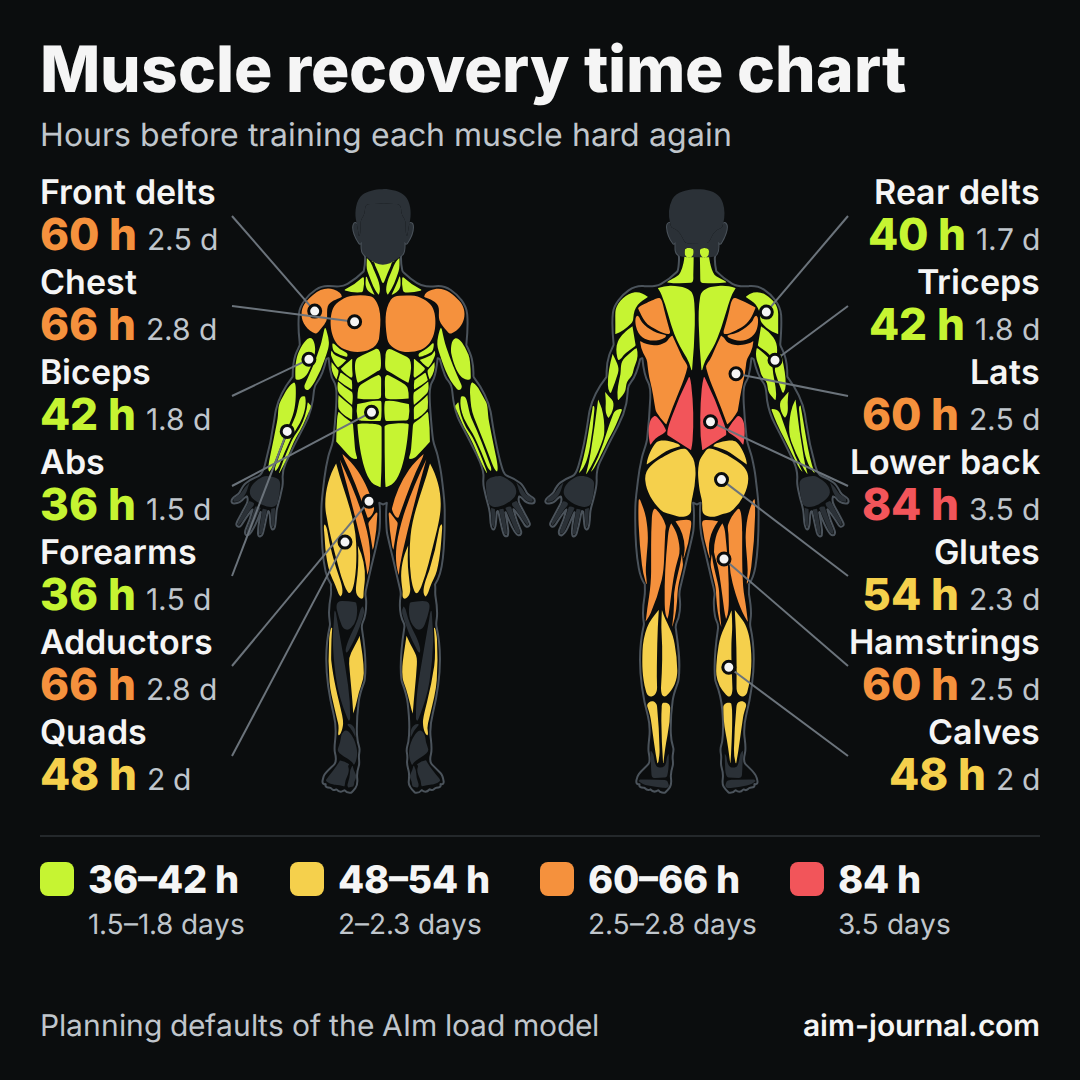
Method and authorship. The AIm editorial team documents the model used in the product and last reviewed this page on 3 October 2026. No clinical reviewer is claimed. The table combines coaching assumptions with the limited exercise-specific research linked below.
These numbers are internal planning defaults used by the AIm load model. They do not establish that a particular muscle has biologically recovered, and they should not override pain, impaired performance or medical advice.
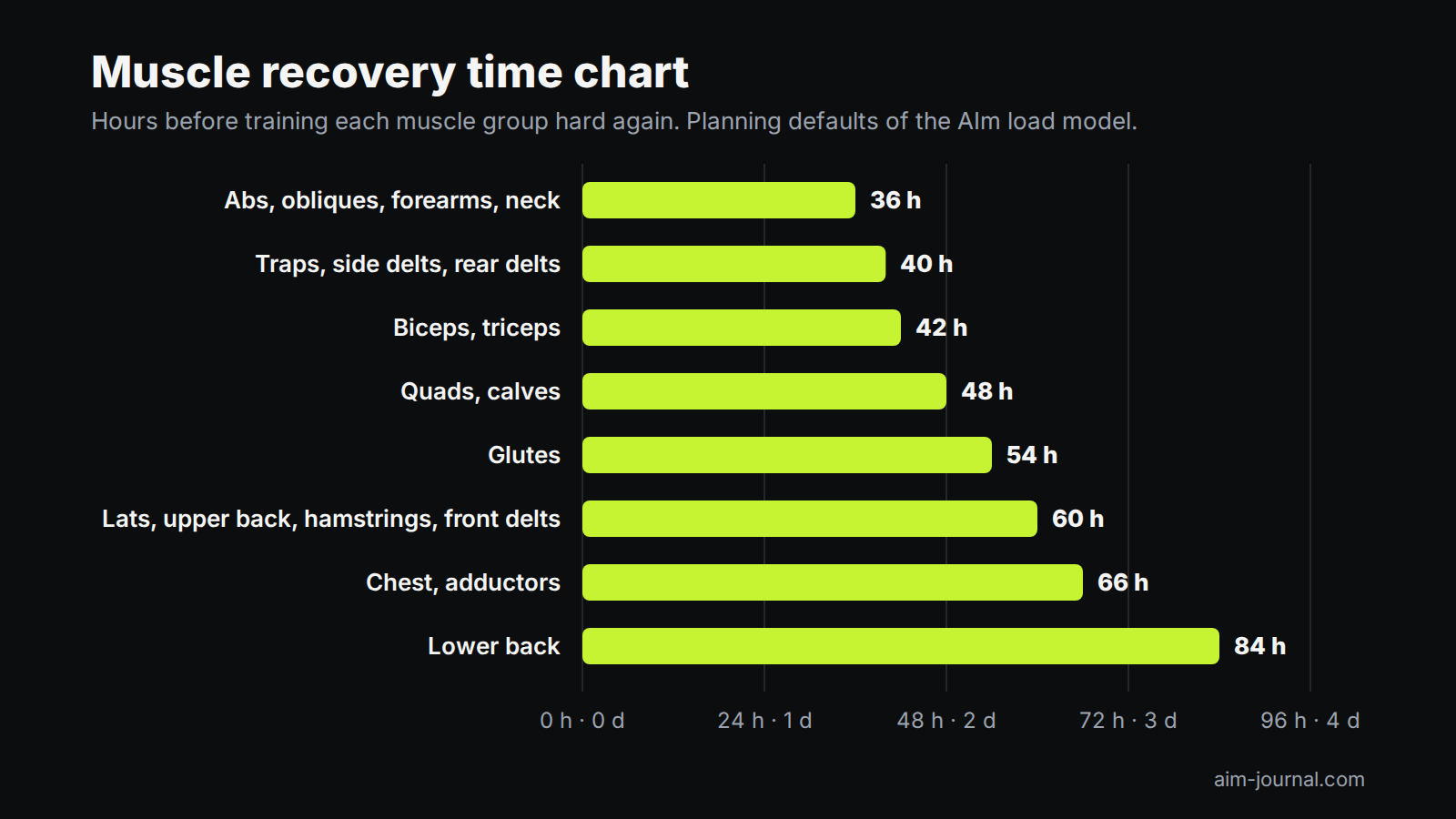
| Muscle group | Hours | Days |
|---|---|---|
| Abs, obliques, forearms, neck | 36 | 1.5 |
| Traps, side delts, rear delts | 40 | 1.7 |
| Biceps, triceps | 42 | 1.8 |
| Quads, calves | 48 | 2 |
| Glutes | 54 | 2.3 |
| Lats, upper back, hamstrings, front delts | 60 | 2.5 |
| Chest, adductors | 66 | 2.8 |
| Lower back | 84 | 3.5 |
Two rows usually surprise people. Arms sit at 42 hours, below quads at 48. And the lower back is the slowest thing on the list by a wide margin, at three and a half days.
Where these numbers come from, and what they are not
They are practitioner heuristics, not literature-derived recovery times. In the studies reviewed for this model we did not find a controlled comparison covering every muscle in this table. The available studies use different exercises and outcomes such as torque, soreness, swelling and blood markers, so they cannot validate one universal clock.
Two justifications this table used to carry were withdrawn after an adversarial review, and it is worth saying which:
- The fibre-type argument is gone. An earlier rationale claimed that slow-twitch groups recover faster. The muscle fibre data in Johnson et al. 1973 do not support the grouping used by the model, and the papers reviewed did not establish a direct recovery timetable from fibre composition.
- Arms are no longer ranked slowest. Chen et al. 2011 observed a greater eccentric-damage response in the tested elbow flexors than knee extensors. The earlier table treated that as a recovery ranking. The current arm value instead reflects a practitioner assumption; Chen did not measure when another session becomes appropriate.
Belcher et al. 2019 observed broadly similar recovery responses after squat, bench press and deadlift protocols in well-trained men. That result applies to the tested protocol and population; it does not prove that every deadlift session has the same recovery cost as every squat session. The 84-hour lower-back value remains an internal coaching assumption without a controlled muscle-specific time course.
Three rows were never verified against anything: adductors, neck and obliques are placed by analogy with their neighbours. Treat them as the softest numbers on the page after the lower back.
What actually changes the number
The muscle row is only the model's starting point. It also considers three properties of the recorded set:
- Exercise selection. In 14 untrained men, Dourado et al. found different recovery courses after their leg-press and knee-extension protocols. This supports treating exercise choice as relevant, not applying a fixed multiplier to every multi-joint lift.
- Long-muscle-length work. A 2024 narrative review by Sousa et al. discusses why eccentric work at longer muscle lengths may increase disruption. It is a reason for caution, not proof that every hinge or lunge needs a particular number of extra hours.
- Training to failure. In ten trained men, Morán-Navarro et al. 2017 found delayed recovery after failure protocols involving bench press and squat. The study supports adjusting conservatively; it does not justify adding exactly one day to every muscle.
AIm applies these per set rather than per session, reading the exercise's own category and movement pattern from the catalogue instead of guessing from how many muscles a lift lists. The guess disagrees with the stated category on hip thrusts and face pulls, which is why it is only the fallback for an exercise nobody has catalogued.
Why legs need 72 hours is about the exercise, not the tissue
A fixed rule for all leg training hides important differences between exercises. A squat and a leg extension load different tissues and are not interchangeable recovery tests.
AIm therefore uses the muscle row as a starting value and then adjusts its estimate from the exercise category, movement pattern and reported effort. This is a description of the product model, not evidence that quadriceps are ready after an exact number of hours.
Soreness is not the signal
Soreness and readiness are not the same measurement. Soreness can change with exercise novelty and does not by itself establish whether performance has recovered.
Use several signals together: pain, current performance, perceived effort and time since the session. The table supplies only the last of those as a planning estimate.
Turning hours into a week
Dividing 168 hours by a model window gives a scheduling illustration, not a physiological frequency limit:
- In the model, a 36 to 42-hour default can fit three evenly spaced entries in one week.
- A 48 to 60-hour default can fit roughly two entries.
- A 66-hour default leaves less room between two entries.
- An 84-hour default does not fit two evenly spaced entries inside every seven-day window.
These examples describe how AIm spaces work in a calendar. They do not prescribe an optimal frequency, which also depends on volume, intensity, exercise choice and the individual response.
Seeing it instead of counting it
AIm calculates an estimate from logged sets: modelled load decays over time, overlapping sessions add up, and the result appears on a body map. Green means lower estimated load; a brighter colour means higher estimated load. The map does not measure biological recovery.
Instead of remembering every internal default, you can inspect the estimate and ask the coach to consider it alongside your current performance and feedback:
How the number on the body map is counted
Tap a muscle in AIm and it shows a percentage. That number is a dose of recorded work, not a measurement of your body. Here is the whole calculation, so none of it has to be taken on trust.
Every set deposits credit on the muscles the exercise trains. A muscle the exercise is built around takes the full amount. A muscle that assists takes half. A muscle that only helps a little takes 0.15 of a set. Those first two are the two blocks you see when you tap a muscle: work aimed at it, and work it merely helped with. Stretching, mobility and cardio deposit nothing at all. They are training, but they are not a resistance dose, and while they counted, a logged warm-up left the lower back sitting at 43% for three days.
Time counts a hold the way reps count a set. Work dosed in time rather than repetitions — planks, dead hangs, loaded carries — used to deposit one set whether it lasted ten seconds or two minutes. The duration prices it now, against a reference hold of 60 seconds with no weight, or 30 seconds when you are carrying one, since the load is doing some of the work the clock does in a bodyweight hold. The credit follows the square root of the time, so 60 seconds of a plank is about one working set, and holding it four times as long is worth twice as much rather than four times. Both ends stop: below a quarter of the reference it stays at half a set, and past four minutes it stays at two.
How hard a set was. If you write down how many reps you had left, that answer wins over every estimate below; only a timed hold is still also priced by its duration. Otherwise every working set counts as one, and the weight only matters when the set was clearly light: AIm estimates the one-rep max each set implies from its weight and reps and compares it with a reference for that lift built only from your earlier days: the weakest of the best sets of your last three days with it in the past six months. A set that implies under 70% of that counts for less, down to 0.7 of a set at 50%. Two estimates are then multiplied in. If today's best set on a lift beats your best on it in the last four weeks by more than 3%, its sets count up to 15% more, while repeating anything you did in those four weeks earns nothing. And the rating you give a workout at the end moves its sets by up to 20% up or 15% down when it differs from your usual rating, the middle of your last five, by more than one point; that starts once you have rated three workouts in the past eight weeks. Together the two never add more than 25%. These limits are our choices, not values a study supplies. A timed hold is priced by its duration; any other set with nothing to compare against counts as one.
Credit fades from the moment the workout starts. When a workout was logged without a time, it is counted by the day instead. It decays smoothly rather than falling off a cliff, and the muscle row in the chart at the top of this page sets the speed: the half-life is a quarter of that window. Half of a quads set is gone 12 hours later; half of a lower back set takes 21. Overlapping sessions simply add up, which is why a second leg day lands on top of the first instead of replacing it.
The percentage is measured against one hard session — one of yours. Until there is enough logged, the denominator is a coaching default: a third of the muscle's weekly volume target, never less than 5 sets. On that default the same six fresh sets read 100% on the quads and 90% on the chest. Once a muscle has three training days behind it, AIm switches the denominator to what your own hard sessions actually deposit on that muscle — the middle of your three biggest days in the eight weeks before that workout, counting assisting work exactly the way the number above counts it. Each workout keeps the bar it had on its own day, so the workouts after it never re-price it, and the number never rises while you rest. Logging a forgotten workout into the past is the exception: it becomes part of the bar for the days after it. It fades in over the following sessions rather than switching, so the figure never jumps because a threshold was crossed. It can only ever raise the bar, never lower it, and today's session never counts toward the bar today's session is measured against.
Why it is personal at all. The weekly targets are stated in sets aimed straight at a muscle, and some of them are deliberately low because a muscle already gets a lot of work indirectly: the front delts are pressed through on every chest day. Dividing everything a muscle received by a target that assumed most of it would arrive indirectly is a unit mismatch, and it made the front delts read 196% of a hard session on a day the chest doing the same pressing read 147%. Measuring the denominator the same way as the numerator is what removes that. The shape of it — comparing your current load against your own recent baseline instead of a population number — is the standard approach in training-load monitoring; the specific window and cut are our choices, tested by replaying real logs, not values any study supplies.
It can go past 100%, and that is not a bug. Two heavy days inside the window read 130%, because there is more work in that muscle than one hard session puts there. The number keeps counting. Only the colour stops, since the map runs out of red at one hard session.
What the model cannot see. It never measures force, soreness, swelling or anything in your blood. It does not know your sleep, your food or your stress. It has nothing to say about tendons and joints, which repair slower than muscle. It has no separate whole-body fatigue: each muscle is counted on its own, so a 25-set leg day and a 25-set arm day differ only in which muscles light up, though only one of them ruins tomorrow. How hard a set was is an estimate built from the weight, your recent best and your own rating, not a measurement of how close you came to failure.
And the hours underneath it are still a practitioner heuristic. Everything above is arithmetic on top of the table at the start of this page, and that table is a set of coaching defaults rather than a result read out of the literature. A percentage computed precisely from an assumed number is still an assumption. Treat it as a planning estimate, and check it against pain, against what you actually lifted last session, and against how the work felt.
What your own week is still carrying
The chart and the arithmetic are the same for everyone. What differs is what you actually logged. On the Home screen of AIm, tap a muscle on the body map: it shows how much of a hard session is still in that muscle, about when it clears, and the sets from the last 7 days that put it there. It is the same estimate described above, so read it next to how you feel rather than instead of it.
Before you plan your next session, which of your muscles is still carrying the most?
Frequently asked questions
How long should I wait before training the same muscle again?
Between 36 and 84 hours depending on the muscle, using the chart above as a planning starting point rather than a measured limit. Multi-joint lifts, loading at long muscle length and sets taken to failure all extend it; the studies support adjusting conservatively, not adding an exact extra day.
Do arms really recover faster than legs?
The model assigns arms 42 hours and quadriceps 48, but this is a practitioner assumption rather than evidence that arms biologically recover faster. The cited damage study did not measure readiness for the next session.
Why is the lower back the slowest?
The model assigns the lower back its longest default at 84 hours. This reflects a conservative coaching assumption about axial fatigue, not a controlled muscle-specific recovery measurement.
Does the deadlift need more recovery than the squat?
One small study in well-trained men found broadly similar responses after its squat and deadlift protocols. That does not settle every exercise variation, load or athlete, so AIm treats exercise choice and reported effort as context rather than claiming a universal difference.
Does age or sex change muscle recovery time?
AIm does not change the hours by age or sex. A 2025 meta-analysis of 36 studies by Fernandes and colleagues found no difference in lost strength between younger and older adults, and more soreness and creatine kinase in the younger groups. For sex, the studies reviewed for this model did not agree on a direction. People of the same age and sex also respond very differently to the same session, so the model reads what you logged instead of a demographic adjustment.
If I am not sore, am I recovered?
Not necessarily. Soreness and recovered performance are different measurements. Consider pain, current performance, perceived effort and time since the session together.
Do sleep and food change these numbers?
They change the real recovery, certainly, and no chart can read your sleep. What a table like this gives you is a planning default from the training itself. Treat a bad week of sleep or a deficit as a reason to sit further from the ceiling, not as a reason for a different number.
Why does a muscle show more than 100%?
Because the percentage is measured against one hard session, not against a ceiling. Two heavy days inside the window put more work into the muscle than a single session does, so it reads 130%. The colour on the map stops changing above one hard session; the number does not.