 AIm
AIm
Push pull legs or upper lower: the workout split for your week
Pick the split by the number of days you can really train, not by what is popular. Two or three days: full body. Four: upper lower. Five: upper lower plus a push pull legs day. Six: push pull legs run twice. When the weekly number of sets is the same, studies find little difference in muscle growth between training a muscle once, twice or three times a week, so the split is mostly a way to fit your sets into your week. Below: the reasoning for each, three ways to split 3 days, a push pull legs plan with sets and reps, and how to ask ChatGPT or Claude to build the split for you.
Start with the only variable that matters
Before comparing splits, answer one question honestly: how many days a week will you train, on a bad week rather than a good one? Not how many you would like to. The split follows from that number, and almost every bad split choice comes from answering it optimistically.
It decides so much because a split is how your weekly sets get spread across the days. A 2019 meta-analysis of 25 studies found no significant difference in muscle growth between training a muscle once, twice or three times a week when the weekly number of sets was the same. What frequency changes is the packaging: ten sets for a muscle fit comfortably into two sessions of five, and less comfortably into one session of ten. And a split that spreads your body over six days only works if you actually turn up six times. Miss two and whole muscle groups got nothing that week.
Push pull legs or upper lower: the short answer
Push pull legs or upper lower is a question about days. Upper lower fits four days and trains each muscle twice. Push pull legs fits six days run twice through, or three days run once. With four days, choose upper lower; with six, push pull legs; with three, read the next section.
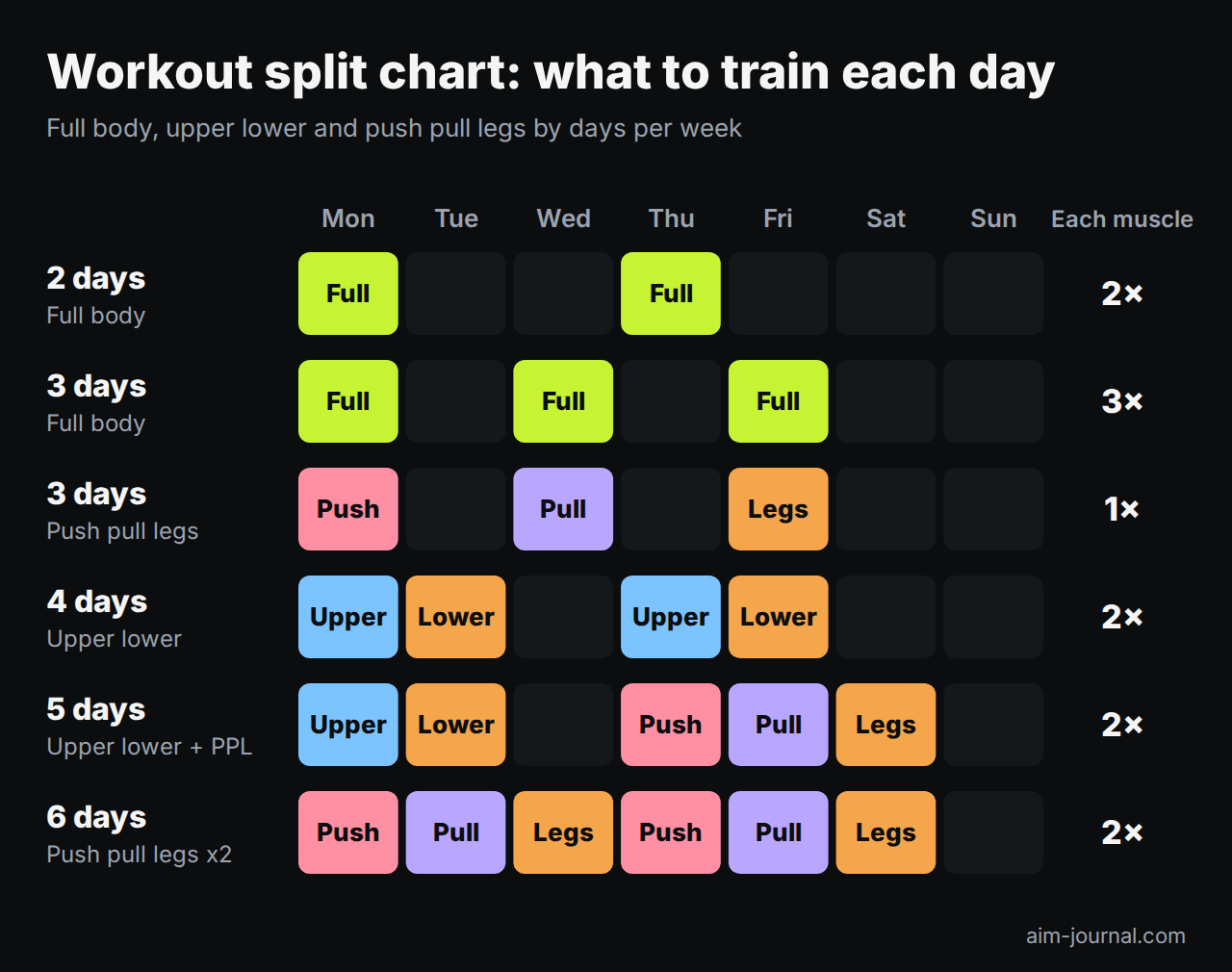
| Days a week | Sensible choice | Each muscle |
|---|---|---|
| 2 | Full body | 2x |
| 3 | Full body | 3x |
| 4 | Upper lower | 2x |
| 5 | Upper lower plus a PPL day, or a bro split | 1 to 2x |
| 6 | Push pull legs, twice through | 2x |
Most rows train each muscle twice a week: its sets fit into two sessions of sensible length, and a missed day costs half of its week rather than all of it. How long each muscle wants between those two days is in the muscle recovery time chart.
A 3 day workout split
Three days is where people hesitate most, because three splits fit and each one trains a muscle a different number of times.
- Full body, three times. Every session trains the whole body with one or two exercises per major muscle, so each muscle gets three small doses a week and a missed day costs a third of its week. This is the default for beginners and for anyone whose schedule collapses regularly. The catch: the muscles you train last are always the tired ones, so rotate which body part opens the session.
- Push pull legs, once through. One day each for pushing muscles, pulling muscles and legs. Each muscle is trained once, so all of its weekly sets land in one longer session, and a missed day takes that muscle's whole week. The plan below is written for this.
- Upper lower, alternating. Upper, lower, upper one week, then lower, upper, lower the next. Each muscle gets three sessions every two weeks, and the plan carries straight over if you later find a fourth day.
| Day | Full body example, sets x reps |
|---|---|
| Mon | Squat 3x6-8; bench press 3x6-8; barbell row 3x8-10; lateral raise 2x12-15; lying leg curl 2x10-12 |
| Wed | Romanian deadlift 3x8-10; pull-up or lat pulldown 3x6-10; overhead press 3x8-10; lunge 2x10-12 per leg; dumbbell curl 2x10-12 |
| Fri | Leg press 3x10-12; incline dumbbell press 3x8-10; seated cable row 3x10-12; triceps pushdown 2x10-12; standing calf raise 3x10-15 |
That gives chest, back and quads six to nine direct sets a week; add a set to the first two lifts of each day if you want more. A push and pull split, where everything that pushes goes on one day and everything that pulls on the next with legs folded in, is a four day variant of the same idea, and it gives legs less attention than any split with a lower day.
Upper and lower for 4 days
Alternating upper body and lower body days, twice each across four days.
Suits: four days a week, and it is arguably the best default for most intermediate lifters.
Why it works: four sessions give every muscle two exposures a week, so its weekly sets split into two sessions and you can do real volume without a two hour workout.
The catch: upper days carry a lot: chest, back, shoulders and arms all want attention. Expect them to run longer than leg days, and be willing to let arms ride on the compound work some weeks.
Push pull legs, and the plan you can copy
Pushing muscles (chest, shoulders, triceps), pulling muscles (back, biceps), then legs. Run once through for three days a week, or twice for six. Muscles that work together are trained together, so nothing is asked to perform twice while still sore, and it is easy to remember. At three days each muscle is trained once and the sessions get long if you want real volume; at six the sets spread out nicely, and it is also six days. Be honest about which version you are actually running.
The plan below is an example, not a prescription. It assumes a gym with a barbell, dumbbells and a cable station, no injuries, and a few months of lifting behind you. Swap any exercise for one you can do well, and pick weights that let you stop each set with one to three good reps left.
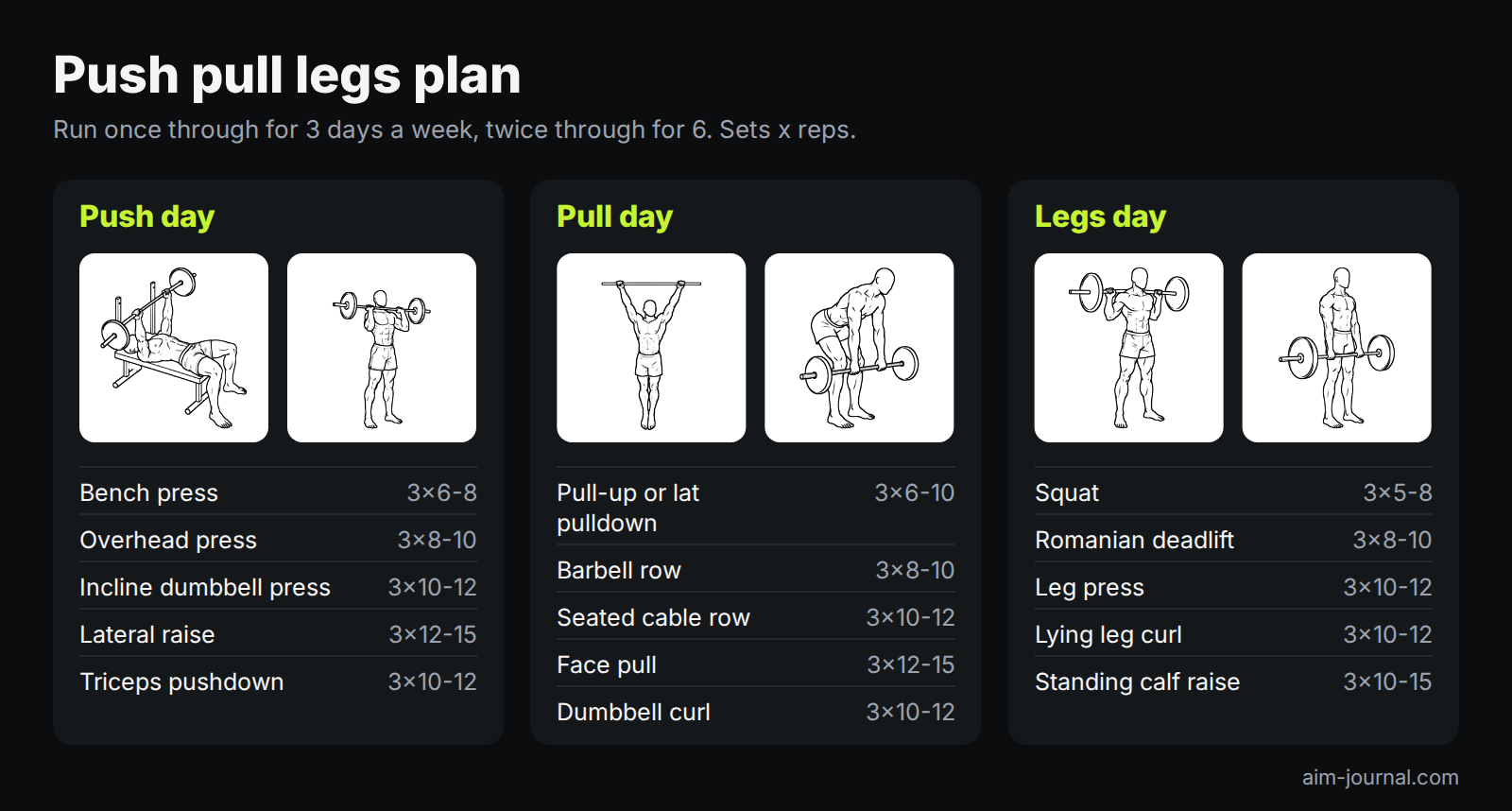
| Day | Exercises, sets x reps |
|---|---|
| Push | Bench press 3x6-8; overhead press 3x8-10; incline dumbbell press 3x10-12; lateral raise 3x12-15; triceps pushdown 3x10-12 |
| Pull | Pull-up or lat pulldown 3x6-10; barbell row 3x8-10; seated cable row 3x10-12; face pull 3x12-15; dumbbell curl 3x10-12 |
| Legs | Squat 3x5-8; Romanian deadlift 3x8-10; leg press 3x10-12; lying leg curl 3x10-12; standing calf raise 3x10-15 |
Rest about two to three minutes on the first two lifts of each day and one to two minutes on the rest. When you reach the top of the rep range on every set, add the smallest weight step and start again at the bottom of the range.
Run once through over three days, the plan gives most muscles three to six direct sets a week, which is on the low side for growth. Run twice through over six days, those numbers double. If six days is not realistic, either add a set to each exercise in the three day version, or put the same exercises into the four day upper lower above. The progressive overload guide lists weekly set ranges per muscle if you want to check the numbers.
To train from it, copy the table into a chat with your assistant connected to AIm and ask it to move the plan in as it is (the plan import guide covers what to check before saving):
The plan then appears on the Workouts tab of the app. Open a day, press Start the workout, and enter the weights as you go. The next time you do those exercises, what you lifted last time is shown next to each set.
The bro split
One muscle group per day: chest Monday, back Tuesday, and so on across five days. It suits lifters who want a lot of volume on one muscle and genuinely enjoy training that way, and it has built plenty of muscle on people who trained hard.
The catch is frequency: once a week per muscle means every set for that muscle fits into one session, and a missed session costs a lot. Skip Thursday and your shoulders got nothing for seven days. It also needs five sessions to work at all.
Asking ChatGPT or Claude for a split
A chat assistant writes a reasonable split in seconds, and it writes a better one when it knows the three things that decide it: how many days you really have, what equipment you can use, and how long a session can last. Put all three in the first message:
The weak point of a plan written in a chat is that nothing checks it. The assistant can put five sessions into a three day week, write a 90 minute day for someone who has 45, or plan a cable exercise for someone training at home, and the chat moves on.
With AIm connected, the plan is checked before it is saved against the days and session length in your training profile, your equipment and any injuries you told it about, and every loaded exercise must carry a starting weight. A plan that fails is not saved until the assistant fixes what was flagged. Once saved, it appears on the Workouts tab of the app, ready to start.
Checking it is working
Split choice decides when a muscle is trained, not how much it grows; weekly hard sets, added load and turning up do that. So pick the row that fits your week and keep it for months: switching split every six weeks makes progress harder to see and harder to keep. The progressive overload guide covers when to add weight, and the 1RM calculator turns any set into a comparable strength number.
The useful check is whether each muscle is getting enough hard sets across the week, and that is arithmetic nobody keeps doing by hand for long.
With AIm connected, the assistant builds the split around your real days and equipment, or saves the plan you already have. After a week of training on it, tap a muscle on the body map on the Home screen of the app: it shows how many sets went straight at that muscle in the last 7 days, next to a weekly range to aim for. Which of your muscles came in under its range last week?
Frequently asked questions
Is push pull legs better than upper lower?
Not by itself. At six days PPL gives every muscle two sessions, the same as upper lower at four, and at equal weekly sets growth is similar either way. Run PPL over three days and each muscle gets all of its weekly sets in one session, which can work but makes sessions long. Choose by the days you actually have.
What is the best 3 day split?
Full body, for most people: each muscle is trained three times a week in smaller doses. Push pull legs run once through also fits three days and trains each muscle once, a fine choice if you can fit enough sets into each session.
What is the best workout split for muscle gain?
The one matching the days you reliably train. Two or three days: full body. Four: upper lower. Six: push pull legs run twice. Growth comes from the weekly hard sets and adding load over time; at equal sets, how often a muscle is trained matters little.
Can ChatGPT or Claude make a workout split?
Yes, and the result is better when the first message states your days, your equipment and how long a session can last. What a chat does not do on its own is check the plan against those limits. Connected to AIm, the assistant's program is reviewed against your training profile before it is saved, and you train from it in the app.
What is the best workout split for beginners?
Full body, three days a week. It teaches the main lifts fastest because you practice them every session, each muscle is trained three times a week, and a missed day costs you a third of the week instead of a whole muscle group.
What is the best workout split for fat loss?
The same split you would run for muscle gain. Fat loss is decided by the calorie deficit, not by the split, and the job of lifting in a deficit is to keep the muscle you have. Pick the split that matches your days, keep the weights heavy, and put cardio after lifting or on rest days rather than redesigning the week around it.
What is the best workout split for women?
The same logic applies: pick by the days you actually have. What usually differs is emphasis, not structure. If glutes and legs are the priority, a four day upper lower with the lower days first in the week fits that goal without inventing a special split.
What is the best 5 day split?
An upper lower plus push pull legs hybrid covers every muscle twice in five days. The bro split covers each muscle once, so all of a muscle's weekly sets land in one session and a missed day costs that muscle's whole week. The hybrid is the easier default unless you enjoy one muscle per day.
Is the bro split bad?
No, it is just demanding: five sessions a week to cover the body once, and a missed day costs a whole muscle group for the week. Trained hard and attended consistently, it works.
What is the best workout split for an aesthetic physique?
There is no special aesthetics split. Proportions come from biasing volume toward the muscles that set the look, usually shoulders, upper chest, lats and arms. Pick the split by your days, then give those muscles the first slot in the session and a couple of extra sets each week.
How often should I change my split?
Rarely. A split is worth keeping for months, because the progress comes from adding load within it. Change when your available days change, not because progress slowed for two weeks.