 AIm
AIm
How to track progressive overload, and when to add weight
To track progressive overload, log the same four things for every working set: the exercise, the weight, the reps and how many sets you did. Then follow one rule: when every set reaches the top of your rep range, add the smallest weight step and start again at the bottom. Below: what to log, the double progression method with an example, how much weight to add, how many sets per muscle, and how to tell a stall from a bad day.
What progressive overload means
Progressive overload means gradually increasing the demand you place on a muscle over time, so it has a reason to keep adapting. Do the same workout with the same weight for a year and your body has no reason to change: it is already comfortably able to do that.
It is not the same as adding weight every session. Weight is the most visible thing to increase, but reps, sets and cleaner execution count too, and for most people past the first few months reps move more often than the bar. That is why it has to be tracked: the progress is often one rep at a time, and one rep is easy to forget.
What to log for every set
For every working set, write down:
- The exercise, under the same name every time. Incline dumbbell press on Monday and incline DB bench on Thursday become two histories, and neither shows the trend.
- The weight, in the same unit, including the bar.
- The reps you actually completed, not the ones you planned. A set of 10, 9, 8 is the information; 3x10 written from habit hides it.
- How many working sets you did. Warm-up sets do not count toward progress or toward weekly volume.
Optional, and useful: a short note on effort, such as two reps left in the tank, and anything that changed the conditions, like a new grip or a different machine. A note that explains a bad session stops you from reading it as a stall later.
Double progression: add reps, then weight
Double progression is the simplest way to decide when to add weight, and it removes most of the guesswork. Pick a rep range, for example 3 sets of 8 to 12. Keep the weight the same and add reps until every set reaches 12. Then add the smallest weight step, drop back to 8 and climb again.
| Week | Weight | Reps per set |
|---|---|---|
| 1 | 60 kg | 9, 8, 8 |
| 2 | 60 kg | 10, 10, 9 |
| 3 | 60 kg | 12, 11, 10 |
| 4 | 60 kg | 12, 12, 12 |
| 5 | 62.5 kg | 9, 8, 8 |
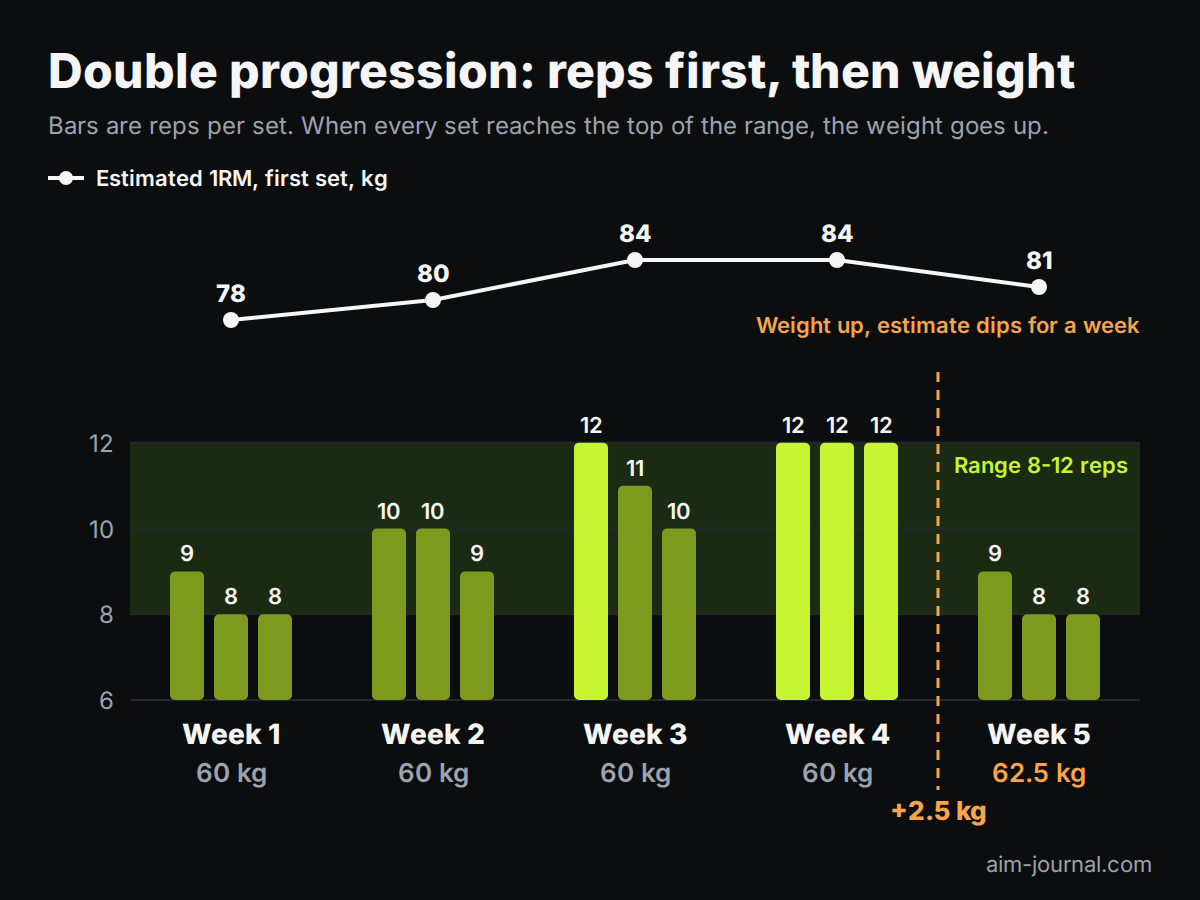
In week 4 every set reached the top of the range, so week 5 adds 2.5 kg and the range starts over. The reps climbed for three weeks without the bar getting heavier, and every one of those weeks was progress. It works with any range: 5 to 8 for heavy compound lifts, 10 to 15 for isolation work such as lateral raises.
Two refinements. Wait until the last set reaches the top too, not just the first: 12, 12, 9 means the weight is still right. And when both reps and weight have stopped moving for a few sessions, the other two levers are an extra set across the week and cleaner execution, such as a fuller range of motion or a controlled lowering.
How much weight to add each week
Add the smallest step your gym allows, and only when the double progression rule says so, not on a calendar. On a barbell that is usually 2.5 kg in total, which is about 4 percent of a 60 kg lift. On a lateral raise or a curl the jump to the next dumbbell can be 15 to 20 percent, so climb the reps for longer there, or use a range that runs up to 15 before switching.
Over months the pace is slower than feels satisfying. A useful rule of thumb is roughly 5 to 10 percent over 8 to 12 weeks on a given lift, not per session. Beginners move faster than that for the first few months, because much of the early gain is the nervous system learning the movement rather than new muscle.
The practical test is not the calendar, it is whether you completed your target reps with technique you would be happy to show someone. If the last set fell apart, repeat the weight next time. A repeated week is not a lost week.
How many sets per muscle per week
This is where adding load usually goes wrong, because more is intuitive and wrong past a point. Two numbers are worth knowing per muscle: a floor below which it barely grows, and a ceiling past which extra sets mostly buy fatigue.
The ranges follow the Renaissance Periodization guides and the Schoenfeld dose-response meta-analyses: growth climbs steeply toward about 10 hard sets a week and flattens out somewhere past 20. They are also the weekly ranges AIm shows when you tap a muscle on its body map. Both columns are hard sets per week.
| Muscle | Floor | Ceiling |
|---|---|---|
| Chest | 8 | 20 |
| Lats | 8 | 20 |
| Upper back | 8 | 20 |
| Quads | 8 | 18 |
| Side delts | 8 | 20 |
| Calves | 8 | 16 |
| Hamstrings | 6 | 16 |
| Biceps | 6 | 16 |
| Triceps | 6 | 14 |
| Rear delts | 6 | 18 |
| Front delts | 6 | 12 |
| Glutes | 4 | 16 |
| Lower back | 4 | 12 |
Two things about this table. Front delts and lower back sit low because they already take a beating as helpers on pressing and on most compound lifts, so they rarely need much direct work. And a set only counts if it was genuinely hard: three sets taken close to failure beat six comfortable ones.
How you spread those sets across the week is a scheduling question, which is what the guide to push pull legs or upper lower is about.
How to tell whether you are actually progressing
Session to session, progress is noisy. Sleep, food and stress move your numbers as much as training does, so a single bad session means nothing. What you want is a trend over weeks.
The most useful single number is an estimated one rep max, because it lets you compare sets that used different weights and reps. The common formula is Epley:
estimated 1RM = weight x (1 + reps / 30)
So 100 kg for 5 reps estimates to about 117 kg, and 90 kg for 10 reps estimates to about 120 kg. The second set was the better performance even though the weight on the bar was lower. In the double progression table above, week 4 (60 kg for 12) estimates to 84 kg and week 5 (62.5 kg for 9) to about 81: the estimate dips for a week when the weight goes up, which is normal. Without that conversion it is easy to think you have stalled when you have not.
If you would rather not do the arithmetic, the 1RM calculator runs the same formula and gives you a percentage table for planning working sets.
Treat the estimate as a comparison tool, not a prediction. It is least accurate above about 10 reps and it is not a number you should walk up to a bar and attempt.
When it stalls
A stall is the same weight and the same reps for three sessions in a row on one exercise, not one bad day. In rough order of what to try:
- Check the obvious first. Sleep, food, and whether life got heavier. Most stalls are recovery, not programming; the muscle recovery time chart has a planning default for each muscle.
- Switch variable. If neither reps nor weight has moved in three sessions, add a set, or switch which variable you are pushing.
- Take a lighter week. Cutting volume roughly in half for a week while keeping the weights where they are often lets progress resume immediately afterwards.
- Change the movement. A close variant loads the same muscle with a fresh stimulus and a fresh set of numbers to beat.
What rarely works is simply pushing harder on a lift that has been flat for a month.
Tracking it without a spreadsheet
None of the above works without a record, and memory is not up to the job past a few exercises. Most people start with a spreadsheet and abandon it.
With AIm there are two other ways to keep the record. Run the session in the AIm app, where each set shows what you lifted last time on that exercise, so the double progression decision is made at the bar. Or describe the session to Claude or ChatGPT in a sentence and let it save the log:
With AIm connected, the assistant writes the session to your log, reads your history back, and answers that question from your actual numbers rather than from a general rule. When it plans the next workout, it starts from the weights you last lifted.
The rules on this page are the same for everyone. Whether they are working for you is in your own log: open the Progress tab in AIm and tap a lift to see its top set and estimated max across your recent workouts. Has that line gone up since you started adding load?
Frequently asked questions
How do I track progressive overload?
Log the exercise under the same name every time, the weight, the reps you actually completed and the number of working sets. Before each set, compare with last time on that exercise. When every set reaches the top of your rep range, add the smallest weight step. An estimated 1RM per exercise shows the trend across different weights and reps.
What is double progression?
A way to progress in two steps inside a rep range: first add reps at the same weight, and when every set reaches the top of the range, add the smallest weight step and start again at the bottom. With 3 sets of 8 to 12, the weight goes up after a session of 12, 12 and 12.
What is progressive overload in simple terms?
Gradually giving a muscle more work than it is used to, so it has a reason to adapt. In practice that means adding reps, weight, sets or better execution over time rather than repeating the same workout indefinitely.
What is an example of progressive overload?
Bench press 60 kg for 3x8 this week, work up to 3x12 over the next few weeks, then move to 62.5 kg and start again at 3x8. Reps climbed, then weight, then reps again.
How often should I increase the weight?
When you can complete all your target reps with technique you are happy with. Roughly 5 to 10 percent over 8 to 12 weeks on a given lift is a realistic pace for anyone past the beginner phase, which is much slower than most people expect.
Does progressive overload work for bodyweight training?
Yes. The weight is fixed, so you progress with reps, sets, harder variations and slower tempo. Moving from knee push-ups to full push-ups to elevated feet is progressive overload.