 AIm
AIm
1RM calculator: your one rep max from 5 reps or any set
Enter the weight and reps of a recent set and get an estimated one rep max, plus the working weights for a percentage program. 100 kg for 5 reps comes out at about 117 kg. No need to test a true max: below are the conversion table from 2 to 12 reps, the 1RM percentage chart, and how far to trust the number.
Calculator
Estimated one rep max: 116.7
Counted as 20 reps: past 20 the formula is no longer reliable.
| % of 1RM | Weight | Reps (Epley) |
|---|---|---|
| 95% | 110.8 | 2 |
| 90% | 105.0 | 3 |
| 85% | 99.2 | 5 |
| 80% | 93.3 | 7-8 |
| 75% | 87.5 | 10 |
| 70% | 81.7 | 13 |
1RM from 3, 5, 8 or 10 reps: the conversion table
To turn a set into a one rep max, multiply the weight by the factor for the reps you completed. The last column is the other direction: what percentage of your max that set was.
| Reps | Multiply by | % of 1RM |
|---|---|---|
| 2 | 1.067 | 93.8% |
| 3 | 1.100 | 90.9% |
| 4 | 1.133 | 88.2% |
| 5 | 1.167 | 85.7% |
| 6 | 1.200 | 83.3% |
| 8 | 1.267 | 78.9% |
| 10 | 1.333 | 75.0% |
| 12 | 1.400 | 71.4% |
So 80 kg for 5 reps is 80 x 1.167, about 93.3 kg. A 5 rep max converts to a 1 rep max by multiplying by 1.167, or dividing by 0.857, which is the same thing. A 3 rep max multiplies by 1.1, an 8 rep max by 1.267 and a 10 rep max by 1.333. A single rep needs no conversion: a set of one is the max.
These factors are the Epley formula worked out in advance, so they match the calculator above and the estimated max the AIm app shows for a logged set. They assume the set ended close to failure. A set of 5 with three more reps in the tank was really an 8 rep effort, and converting it as a 5 understates your max.
How to calculate 1RM: the Epley formula
To calculate your one rep max, take a recent set done with good form and multiply the weight by (1 + reps / 30). That is the Epley formula, the most widely used estimate:
estimated 1RM = weight x (1 + reps / 30)
So a set of 100 kg for 5 reps estimates a one rep max of about 116.7 kg. You can do it on paper in a few seconds, which is worth knowing when you are standing in a gym without your phone.
This is the same formula AIm uses internally, so an estimate on this page matches what the app shows for a logged set.
1RM percentage chart
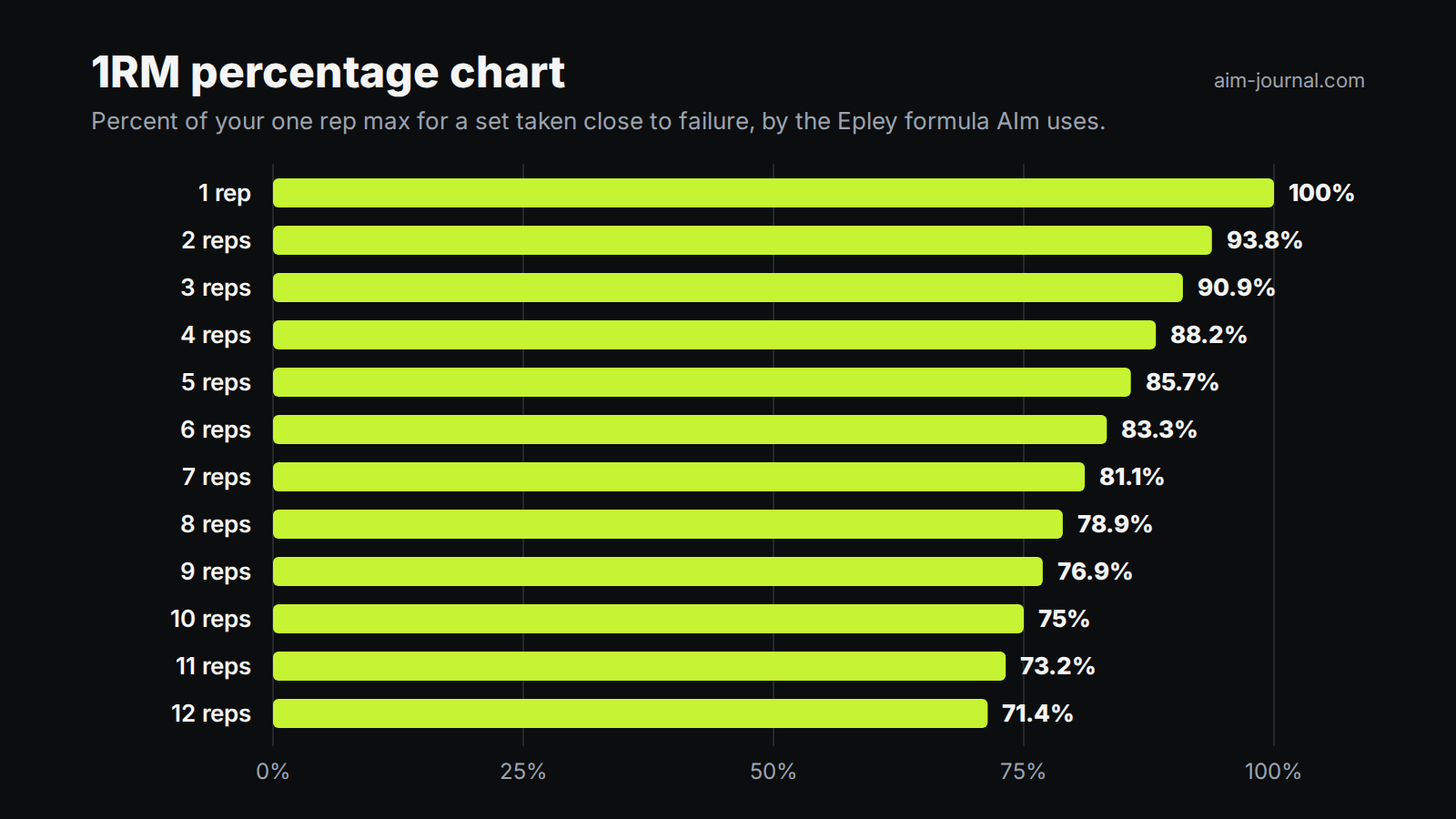
Most published programs prescribe load as a percentage of your one rep max: five sets of three at 85 percent, or three sets of ten at 70. The calculator table converts your estimate into those working weights so you can follow such a program without ever testing a max.
Round to whatever your gym actually has. If the table says 87.5 kg and the smallest plates give you 85 or 90, take 85 and aim to beat the reps.
The rep column in the calculator is what the Epley formula implies for each percentage, rounded to whole reps. It is a starting point, not a rule: how many reps you personally get at 80 percent depends on the lift and on how you train. Squats usually allow more reps at a given percentage than deadlifts do, and someone who lives in the 5 rep range will get fewer reps at 70 percent than someone who trains at 12.
Epley vs Brzycki: which one to trust
Epley is not the only formula. The two other common ones are Brzycki and Lombardi:
- Epley: weight x (1 + reps / 30)
- Brzycki: weight x 36 / (37 - reps)
- Lombardi: weight x reps to the power of 0.10
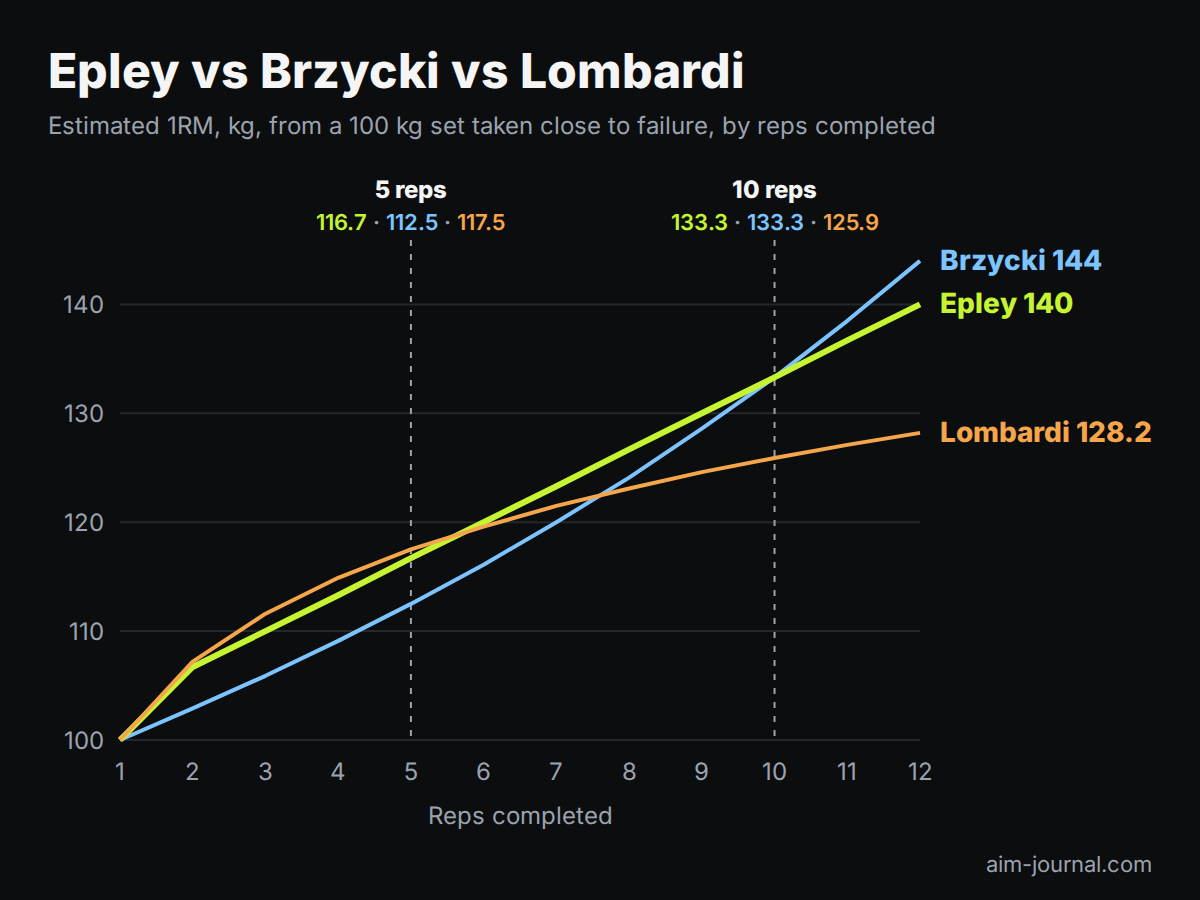
Epley and Brzycki disagree less than their shapes suggest. Below 10 reps Brzycki gives the lower number: 100 kg for 5 is 116.7 by Epley and 112.5 by Brzycki, 100 kg for 3 is 110 against 105.9. At exactly 10 reps they agree, both at 133.3. Above 10 Brzycki climbs faster, and by 12 reps it is the higher of the two. Lombardi stays the flattest: 117.5 at 5 reps, but only 125.9 at 10.
Which to trust: neither formula is right for everyone, and the gap between them is smaller than the gap between two lifters with the same 5 rep set. If you want the more conservative number from a heavy set, Brzycki is it. If you track progress, consistency matters more than the choice. Pick one, use it for every set, and compare the number against your own past numbers. AIm uses Epley everywhere, on this page and in the app, so switching formulas halfway through a training block would show you a jump or a drop that never happened in the gym.
Why estimate instead of testing
An estimate from a normal working set takes no extra effort and can be recalculated after every session; a true max test is a maximal effort with a real injury risk, often needs a spotter, and can leave you too fatigued to train properly for a few days.
How accurate is it?
Good in the middle, unreliable at the edges. Between roughly 3 and 8 reps the estimate is usually close. Above about 10 reps it drifts high, because at that point your set is limited by muscular endurance and technique breakdown rather than pure strength. A set of 20 will produce a number you almost certainly cannot lift.
It is also individual. Two people with the same 5 rep performance can have genuinely different true maxes, depending on fiber type and how practiced they are at heavy singles. Someone who trains mostly in the 8 to 12 range will usually under-perform their estimate on the day.
Bench press, squat and deadlift max
The formula is the same for every lift, but its accuracy is not.
Bench press max
Bench press estimates are the most reliable of the three, because the set usually ends when the chest and triceps fail rather than anything else. A set of 5 taken close to failure gives a number you can plan against.
Squat max
Squat estimates run slightly optimistic from high rep sets, because legs handle high reps better than the formula assumes: you get more reps at a given percentage, so the arithmetic reads that endurance as extra strength. Estimate from 3 to 6 reps and the drift mostly disappears.
Deadlift max
Deadlift estimates drift the most, and high rep sets can read low here rather than high: grip and lower back fatigue end a long set early, so a 10 rep pull can understate what you could lift once. This is the lift where staying in the low rep range matters.
The practical rule: estimate from sets of 3 to 6 reps where you can, especially on the deadlift, and compare estimates from the same rep range over time. An estimate from your 5 rep squat this month against your 5 rep squat last month is a clean comparison. Against your 12 rep squat it is not.
If you log RPE
RPE folds into the same formula through reps in reserve. RPE 8 means you had about 2 reps left in the tank, RPE 9 about 1. Add those reps to the reps you actually did and enter the total in the calculator above: 100 kg for 5 at RPE 8 counts as a 7 rep effort, which estimates about 123 kg.
This is an estimate stacked on an estimate, since RPE itself is a judgment call, so expect a wider error than from a set taken close to failure. The trade is worth it when you want a max number without grinding out the last reps. The estimate AIm shows uses the weight and reps of each set only, the way this calculator does with RPE left out.
Using it to drive progression
The reason an estimated max is worth tracking at all is that it makes different sets comparable. Consider two weeks:
- Week one: 100 kg x 5. Estimate about 116.7.
- Week two: 95 kg x 8. Estimate about 120.
The bar was lighter in week two and the performance was better. Judged by weight alone you would think you had gone backwards. This is the single most common reason people believe they have stalled when they have not.
The guide to tracking progressive overload covers when to add weight and what to change when the trend really has flattened.
Doing that by hand for every exercise gets old fast. With AIm connected, Claude or ChatGPT records the set in your AIm log and answers from your history:
The calculator gives you one number from one set. The trend lives in your log: open the Progress tab in AIm and tap an exercise to see its top set and estimated max from each workout, whether you logged it in chat or ran it in the app. Is your estimate for that lift higher than it was a month ago?
Frequently asked questions
How do I calculate my 1RM from 5 reps?
Multiply the weight by 1.167, which is the Epley formula for 5 reps: weight x (1 + 5 / 30). 100 kg for 5 reps gives about 116.7 kg, 80 kg for 5 about 93.3 kg. It assumes the set ended close to failure.
What percentage of 1RM is 5 reps?
About 85.7 percent by the Epley formula. 3 reps is about 90.9 percent, 8 reps 78.9 percent and 10 reps 75 percent. Individual numbers vary with the lift and with how you train, so treat these as starting points.
How do I calculate my one rep max?
Apply the Epley formula to a set done with good form: weight multiplied by (1 + reps divided by 30). The calculator above does it for you and converts the result into working percentages.
How accurate is a 1RM calculator?
Reasonably accurate between about 3 and 8 reps. Above 10 reps it tends to overestimate, because the set becomes limited by endurance rather than strength. Use it to compare your own sets over time rather than as a prediction of what you could lift today.
Should I test my actual one rep max?
Rarely, and only if you have a reason such as competing. It carries injury risk and costs several days of quality training afterwards. An estimate from a normal working set gives you the same trend information every week at no cost.
Is Epley or Brzycki more accurate?
Neither is right for everyone. Below 10 reps Brzycki gives the lower, more conservative number, at 10 reps the two agree exactly, and above 10 Brzycki gives the higher one. For tracking progress, use one formula for every set. This calculator and AIm both use Epley.